For more recent and complete information, please see my Curriculum Vitae.

Research Activities

I am a Ph.D. Student in Computer Science at Purdue University. The majority of my research at Purdue has focused on prediction and modeling of large dynamic networks. Recently, I have had the opportunity to work with Dr. Sonia Fahmy on analyzing the evolution of the Internet AS topology and on a multi-level approach for evaluating topology generators. I have also worked with Dr. David Gleich on a Dynamic PageRank algorithm. We proposed an evolving teleportation adaptation of PageRank to capture how changes in external interest influence the importance of a node. We model these changes naturally by stating PageRank as a dynamical system. I'm also working with Dr. Jennifer Neville in the Networks Learning and Discovery Laboratory on problems in Statistical Relational Learning. During this time, we proposed a Dynamic Behavioral Mixed-membership Model (DBMM) for analysis and prediction in very large networks. I have also worked on modeling the temporal influence of attributes and links to improve the accuracy of relational classifiers. My broad research interests lie in relational machine learning, statistical relational learning, data mining, network analysis, temporal relational classification, and security. I am also a member of the Statistical Machine Learning group at Purdue University. My research is supported by the NSF Graduate Research Fellowship (NSF GRFP), National Defense Science and Engineering Graduate Fellowship (NDSEG) and the Purdue Frederick N. Andrews Fellowship.

In the summer of 2011 I was at Lawrence Livermore National Laboratory (LLNL) working with Brian Gallagher on problems related to detecting anomalies and mining large temporal networks. I was supported through the LLNL Scholar (Cyber Defenders Program) part of the Computation Directorate. I presented a version of our Temporal Behavioral Model at LLNL and Purdue. [Poster][Presentation]

I previously visited the Naval Research Laboratory in Washington DC and worked with Dr. David Aha in the Navy Center for Applied Research in Artificial Intelligence and Dr. Luke McDowell of the United States Naval Academy. We focused on surveying approaches and opportunities for relational representation discovery. This lead us to introduce an intuitive taxonomy for relational representation discovery that formulates link discovery and node discovery as symmetric representation tasks (predicting their existence, predicting their label or type, estimating their weight or importance, and systematically discovering their relevant features). During my visit, I was supported by the NREIP Fellowship awarded by the Office of Naval Research (ONR).

The majority of my undergraduate studies were spent working with Dr. Jean-Louis Lassez (Retired IBM T.J. Watson Researcher) on many problems from machine learning, information retrieval, bioinformatics, security, and search engines.

Before attending Purdue, I was a research fellow (USRP, SURF, and Space Grant) at NASA Jet Propulsion Laboratory and California Institute of Technology working with Dr. Mark W. Powell on a Scalable Image Processing Framework for Gigapixel Mars Images. I also had the opportunity to work on extending this framework for Cloud Computing with Khawaja Shams (Amazon AWS Case Study: NASA JPL’s Desert Research and Training [txt]) and other members of the Planning Software Systems Group (within the Planning and Exploration Systems Mission Directorate).

During the summer of 2008, I worked with Dr. David Jensen and Brian Taylor at the University of Massachusetts Amherst in the Knowledge Discovery Laboratory (supported by the NSF REU Fellowship). The research investigated peer production and collaborative sensing systems in order to discover causal knowledge from these systems through sophisticated simulation techniques.

I also had the chance to work with Dr. Srinivas Mukkamala and jointly with Dr. Jean-Louis Lassez on problems of dimensionality reduction and real-time intrusion detection systems using a technique we designed based on Singular Value Decomposition and a simpler more robust version of Support Vector Machines (Summer 2007).


Publications (Peer-reviewed)

Ryan Rossi and Jennifer Neville: Time-Evolving Relational Classification and Ensemble Methods, In Proceedings of the Pacific-Asia International Conference on Knowledge Discovery and Data Mining (PAKDD), 2012. [To appear]

Ryan Rossi and Jennifer Neville: Modeling the Evolution of Discussion Topics and Communication to Improve Relational Classification, In Proc. of the 1st SOMA Workshop, 16th ACM SIGKDD International Conference on Knowledge Discovery and Data Mining, 2010. [Paper] [Slides] Also a [Poster]

Jean-Louis Lassez, Ryan A. Rossi, Axel E. Bernal: Crick's Hypothesis Revisited: The Existence of a Universal Coding Frame, IEEE International Conference on Bioinformatics and Life Science Computing, AINA/BLSC, 745-751, 2007. [PDF], Presented in the US, Russia, Japan, Thailand and Canada at various conferences and keynotes. [Slides]

Jean-Louis Lassez, Ryan Rossi, Kumar Jeev: Ranking Links on the Web: Search and Surf Engines, Lecture Notes of Artificial Intelligence, IEA/AIE, 199-208, 2008. [PDF] [Slides]

Jean-Louis Lassez, Ryan Rossi, Stephen Sheel, Srinivas Mukkamala: Signature Based Intrusion Detection using Latent Semantic Analysis, IEEE International Joint Conference of Neural Networks, IJCNN, 1068-1074, 2008. [PDF]

John Stamey, Jean-Louis Lassez, Ryan Rossi, Daniel Boorn: Client-Side Dynamic Metadata in Web 2.0, ACM Press, SIGDOC, 155-161, 2007. [PDF]

Ryan Rossi: Latent Semantic Analysis of the Languages of Life, ISICA, CCIS 51, 128-137, 2009.

Mark W. Powell, Ryan A. Rossi, and Khawaja S. Shams: A Scalable Image Processing Framework for Gigapixel Mars and Other Celestial Body Images, IEEE Aerospace, 2009. [PDF]

Khawaja S. Shams, Mark W. Powell, Tom M. Crockett, Jeffrey S. Norris, Ryan Rossi, Tom Soderstrom: Polyphony: A Workflow Orchestration Framework for Cloud Computing, 10th IEEE/ACM Inter. Conf. on Cluster, Cloud and Grid Computing, CCGrid 2010. [PDF] Also (Amazon AWS Case Study: NASA JPL’s Desert Research and Training [txt])

Brian Taylor, David Jensen, Mark Corner, Ryan Rossi: Experimental Methods for Improving the Design of Participatory Sensing Systems, 2010 (In preparation for submission).

John Stamey, Ryan Rossi: Automatically Identifying Relations in Privacy Policies, SIGDOC, ACM Press, 233-238, 2009. [PDF]


Technical Reports

Ryan Rossi and Jennifer Neville: Representations and Ensemble Methods for Dynamic Relational Classification, CoRR abs/1111.5312, 2011. [PDF]

Ryan Rossi: Discovering Latent Graphs with Positive and Negative Links to Eliminate Spam in Adversarial Information Retrieval, NASA JPL 2009. [PDF]


Research Experience

Research Assistant, Purdue University (2009-Present)
Advisor: Jennifer Neville, Research: Machine Learning, Statistical Relational Learning

Research Assistant, Lawrence Livermore National Laboratory (ISCR)
Advisor: Brian Gallagher, LLNL Scholar: Cyber Defenders Program (Summer 2011)

Research Assistant, Naval Research Laboratory, AI Research Center
Advisor: David Aha, Co-advisor: Luke McDowell, ONR NREIP Fellowship
Relational Representation Discovery in Statistical Relational Learning, (Summer 2010)

Research Assistant, Coastal Carolina University (2005-2009)
Advisor: Jean-Louis Lassez, Retired IBM T.J. Watson Research Center

Research Assistant, NASA Jet Propulsion Laboratory, (Summer 2009)
California Institute of Technology, Space Grant/USRP Fellowship
(Returned to continue my research).

Research Assistant, NASA Jet Propulsion Laboratory, (Spring 2009)
California Institute of Technology, USRP NASA Fellowship
Advisor: Mark Powell (Scalable Image Processing) and Khawaja Shams (Cloud Computing)

Research Assistant, University of Massachusetts at Amherst, KDL, (Summer 2008)
Advisor: David Jensen, Graduate Advisor: Brian Taylor, REU NSF Fellowship

Research Assistant, New Mexico Tech, Institute for Complex Additive Systems
Advisor: Srinivas Mukkamala, Senior Research Scientist, ICASA (Summer 2007)


Poster Presentations

Ryan Rossi, Brian Gallagher, Jennifer Neville, and Keith Henderson, Modeling Temporal Behavior in Large Networks: From Predictive Modeling to Anomaly Detection

Ryan Rossi and Jennifer Neville, Temporally-Evolving Network Classification


Teaching Experience

Search Engine Theory, Instructor, Spring 2008
This course was taught from a machine learning perspective using a variety of resources and recent papers along with a series of homeworks and projects implementing the significant parts of a search engine.

Algorithms in Bioinformatics, Teaching Assistant, Fall 2007
Numerical Methods, Teaching Assistant, Spring 2007
Introduction to Bioinformatics, Teaching Assistant, Fa 2008, Fa/Spr 2007, Spr 2006
Introduction to Algorithm Design II, Teaching Assistant, Spring 2006
Introduction to Algorithm Design I, Teaching Assistant, Spring 2006

As a teaching assistant I gave lectures and review sessions; developed homeworks, labs, and programs, held office hours, and maintained course website.


Books / Lecture Notes

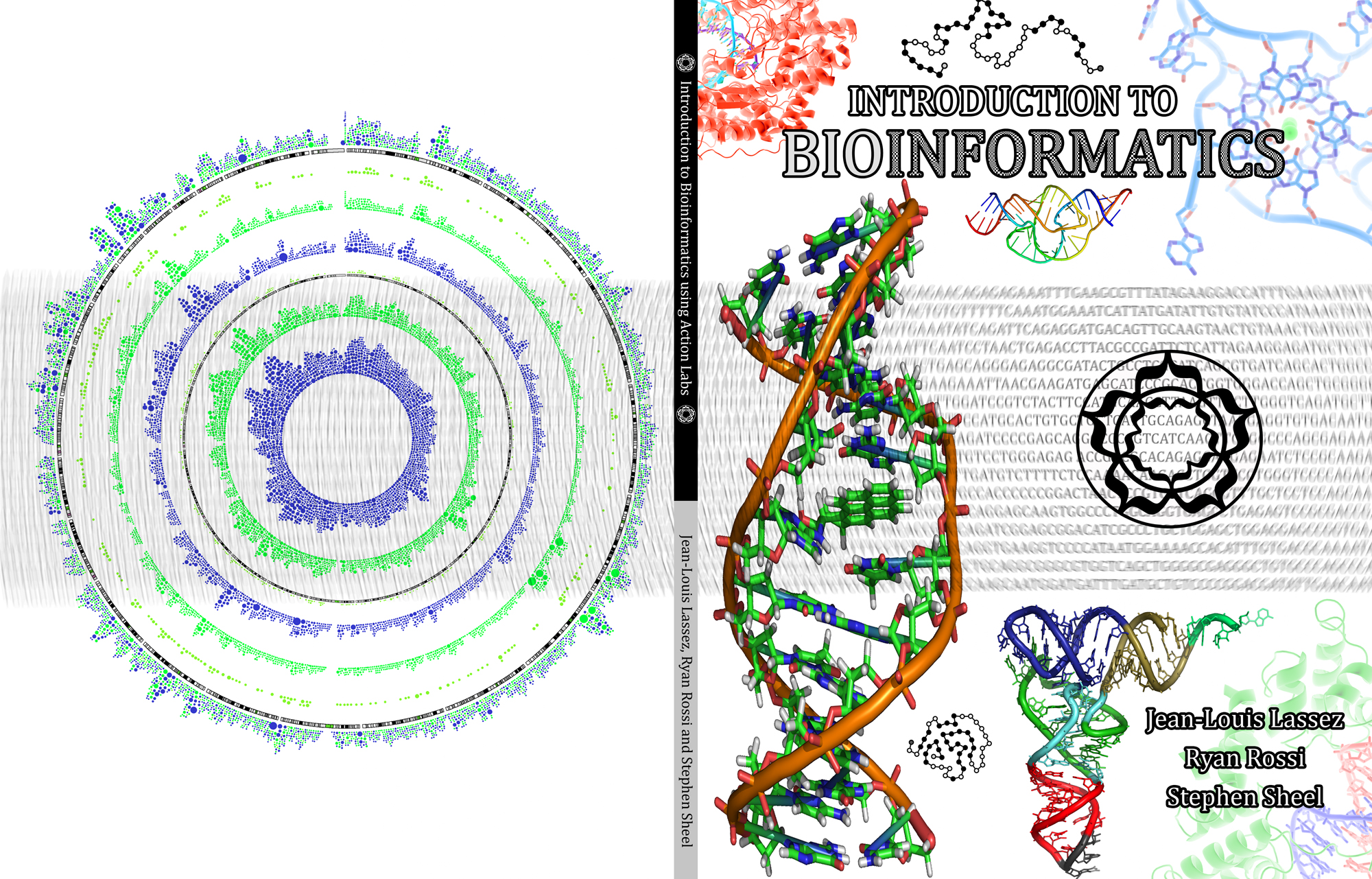
Bioinformatics is the application of computational techniques and tools to analyze and manage biological data. This book provides an Introduction to Bioinformatics through the use of Action Labs. These labs allow students to get experience using real data and tools to solve difficult problems. The book comes with supplementary powerpoints, papers, and tools. The labs use data from Breast Cancer, Liver Disease, Diabetes, SARS, HIV, Extinct Organisms, and many others. The book has been written for first or second year computer science, mathematics, and biology students. The book is published by the Digital University Press. [pdf version] (5.22 MB)


Other News and Information

Some time-evolving behavioral visualizations from one of my recent research projects are shown below. These are from a large scale IP-to-IP communication network. Each plot represents a node, the x-axis represents time, and the y-axis represents the proportion of the structural behaviors at that time.